Showing posts with label culture. Show all posts

Wednesday, March 15, 2023

You don't know?!

Day 15 of 31 at TWT!
"Do you know 'zelenka'?" My Ukrainian student blinks his blue eyes in his characteristic deadpan, almost-ornery way. His casually inquiring tone doesn't give me any clues about what he's asking. I work with him 1-on-1 for a period each day (and then another period where other students also join us), which gives our time together an unusually laid-back atmosphere, with more room than usual for random chitchat. From all our time together, I can guess that he wants to know if I'm familiar with either a video game or something Ukrainian, and this word sounds pretty Russian.

"Ummm... I know zeloni!" I grin sideways at him, remembering my attempts to learn colors in Russian while playing Uno with the Russian speakers at my morning school. "Is it something green?" 

"Not zeloni!" He grins back. "Zelenka!"

"Um, no..." I shrug. 

He pulls his hand up from under the table to show me the finger he scraped a couple days ago when he hit his hand against a table at home while playing VR (a story that made both of us cackle when he told me, despite the injury). 

It's a good thing I'm wearing a mask, because I can't keep my mouth from dropping open as wide as it can go. All the way down his hurt finger, EVERY. BIT. OF. OPEN. WOUND. IS. GREEN.

BRIGHT. GREEN.

SO, SO, SO GREEN.

GREEN, GREEN, GREEN, GREEN, GREEN.

My teacher-mom brain freaks out. Did he COLOR his OPEN WOUNDS with MARKER?!?!?! A 6th grader should know better than that!!! It's going to get all infected!!!!

"Y!!!!!! WHAT DID YOU...??????" I screech, leaning forward and slapping my hands against the kidney table. 

Those bright blue eyes fly open wide. His eyebrows arch and his blond hair flops as he sits up straight in an astonishment that matches my own. "You don't know Zelenka?!?!"

Our mutual astonishment hangs in the air for a moment. 

"It's medicine!" he proclaims, then repeats, his voice still rising with surprise, "You don't know?"

I lean forward to look at his finger more closely, and realize that, shockingly bright green color aside, whatever it is has stained his skin with a consistency similar to iodine. I vaguely think I remember that people put iodine on wounds, sometimes, maybe. "Nnnoo," I sputter. "I don't know this medicine!"

"It's help..." he pauses, then reaches for his Chromebook, pushes the dictation button on Google Translate, and rattles off an adept phrase in Russian. Google Translate spits out "when a wound is festering". 

"So when you are hurt, you put this green medicine on, and it helps your skin heal?" I rub my own finger where his is scraped up. My brain still feels like it wants to explode at the sight of such a brilliant green color on his injured finger. I smile. "I was right though, right? Zelenka, zeloni; it's green!" I'm very proud that I actually guess the meaning of a Russian word with one of the approximately 10 Russian words I've managed to learn this year.

"Yes! But... you don't know?!" He's incredulous that I've apparently been deprived of this medicine my entire life. 

"No!" I lean in. Is this shockingly green medicine truly that commonplace in Ukraine? Does it really work? I'm dying to know more. "How do you put it on? Does it squeeze from a tube or drip from a bottle?" I try to act out those actions. The way his skin is stained really reminds me of iodine, so I predict it comes from a bottle with a dropper, and I'm hoping he'll Google the package so my stunned brain can verify that this is, for real, an actual medicine. 

"It's bottle." He bows his head slightly to say "zelenka" into the Chromebook, copies the Russian text (he likes that way better than trying to use the Russian keyboard), and pastes the word into Google. The screen fills with images of little green bottles reminiscent of iodine bottles, just like I'd predicted.

He glances sideways at me, then repeats, "You don't know?" as if, when I saw the bottle, surely I'd recognize it. 

"No, I don't know this!" I giggle. "Thank you for teaching me!" 

He throws his head back in an uncharacteristically wide-mouthed laugh. 

We move on to practicing narrative elements with a picture book, but my mind flashes back to about a week ago, when he'd asked if I knew a different Russian word, Luntik, which turned out to be a beloved Russian children's tv show. Just like with zelenka, he'd Googled the name, found pictures of the main character (a very adorable pinkish creature), and been absolutely blown away that I'd never heard of it. 

When I get home, I tell Husband about that shockingly green substance, Google "zelenka medicine", and learn that it is truly a common remedy in that part of the world. 

One of my favorite things about teaching ELs is how much I learn from them about the world, and one of the most profound experiences of interacting with someone from another culture are moments like this, when we both realize that something we absolutely held as "normal" is not as universal as we'd thought: that for each of us, our everyday, regular "slices of life" are so much more unique than we realize.

I remember my host mom in Spain cooking EVERYthing (including, to my repeated dismay, our breakfast toast) in olive oil, and trying to tell me that peanut butter was unhealthy (after my roommate and I scoured our supermarket up and down, past rows of Nutella, before finally finding 1 small jar of peanut butter on the Mexican / international shelf). I remember a girl on our Universidad Complutense de Madrid intramural volleyball team (cheer: "¡Fiesta! ¡Sangria! ¡Historia y GeografĂ­a!") asking if cheerleaders were really real. 

It's easy to think about the BIG things that are different from country to country or region to region. But what about all those little moments you grew up internalizing as "normal"? Your typical snack. Your favorite childhood tv show. What your mom puts on your boo-boos. How your mom makes toast. 

Just imagine all the things you. don't. know. 

Tuesday, June 15, 2021

From Indian Two Feet to Fry Bread

Tuesdays at TWT!
When I was a scrawny first-grader with a long blonde braid that swung back and forth across my back as I skipped down the hallway, I checked out an Indian Two Feet (cringe, right?!) book from my school library. For some reason, I fell in love with Indian Two Feet. I checked out every book in the series. I read them again and again. I made my two best friends play Indians with me at recess in a clover patch that we decided was our tipi. I always pretended to be Indian Two Feet (I used to marvel at my oldest daughter's bossiness, but looking back at my childhood play, nearly everything was my idea, and I always played the main parts), while my poor friends played the parts of Indian One Foot and Indian Three Feet (face palm). (Apparently we used up all our creativity imagining that clover patch was a tipi...)  

I couldn't tell you anything about what happened in those books now, although the name was obviously enough to make me terrified about what I'd find when I Googled them. (I found some read-aloud videos of one, and while the story isn't actually as problematic as I'd feared, the original illustrations are atrociously stereotypical, and not much better in a newer version.) But for some reason, my heart and mind were completely smitten with the idea of American Indians after I read those books. (It's entirely possible that these books may have been one of my first encounters with the fact that Native Americans even existed, and I know I wasn't alone.)

As soon as I finished all the Indian Two Feet books in our school library, I wanted to read every book about American Indians I could get my hands on! Fortunately, I was grade levels ahead in reading, with a mom who was passionate about reading, so when I wanted to read about something, I had more than the typical access to materials. I quickly moved on from Indian Two Feet (thank goodness) to devour a wide array of historical fiction, collections of traditional stories, biographies, and informational non-fiction. I researched Tecumseh for my 3rd grade biography assignment and ended up presenting my project in front of the whole school. I'm probably the only kid who ever read Bury My Heart at Wounded Knee (~ 500 pages) and A Sorrow In Our Heart (~ 800 pages) in their entirety before even becoming a teenager. (Sadly, I now recognize that even so much of that wide reading was problematic, mis-informed, embellished, deficit-minded, or too anchored in the past.)

Luckily, my parents fostered my desire to learn in more ways than just with books. We attended powwows where I got to ask questions, hear traditional music, taste delicious foods, view beautiful artwork, and even participate in dances. (Powwow culture is VERY welcoming to visitors and a great way to learn about traditions! It's not weird if you aren't tribally enrolled; public powwows welcome everyone and the people are happy to share with you!) We visited countless museums, historic sites, and cultural centers. We attended every educational program we could find. I learned and learned, and slowly, the stereotypes so easily acquired gave way to a more accurate understanding of various tribes, their unique histories and cultural traditions, and some awareness of modern tribal life. More accurate books were published, and I started learning to discern reliable sources and problematic portrayals. 

When I got a middle school assignment to write to a famous author, I wrote to Joseph Bruchac, an Abenaki author who sent me back a beautiful art print from one of his books. My 35 page senior thesis for AP Lit (I lost a few points for going over the recommended guidelines of 15-20 pages... but I was so excited!) explored themes and symbols of modern American Indian identity in works such as Ceremony and House Made of Dawn. My dad signed me up as a founding member of the National Museum of the American Indian when it opened, and I've learned so much from our trips there and the articles in the member magazine. 

Now, I'm so thankful to be able to share incredible books like Cradle Me and Fry Bread with my daughters and my students; books that show the beauty and resilience of modern American Indians with tribal specificity and cultural accuracy, and a sense that these people are still here. I'm thankful for tribally enrolled citizens who educate on social media and high-quality internet resources that make it possible to access information (and ensure its accuracy) more easily. From home this past year, I've learned about various tribal languages and history from amazing tribally enrolled members across the country through incredible virtual museum and library events.

And the more I learn, I realize there's just so much more to learn. My reading list and my Twitter feed grow. 

I also realize how uncommon this learning is for so many Americans. What would I know about American Indians if I hadn't done my best to learn about them for my whole life? What do most Americans know? Some stereotypes brought on by problematic childhood books. Great big holes in history classes, with a few quick sidebar notes that usually serve to further stereotypes. The impression that American Indians lived a long time ago, and/or in the West. Racist mascots and catchphrases that are so engrained in popular culture that it's easy to think they're ok, just like those old books. Even some recently published books (that you'd hope would be high quality) turn out to be problematic. 

When I Googled Indian Two Feet (and watched the read-alouds to see what it's really like), I was dismayed to find so many positive reviews on both Amazon and Goodreads. Too many reviews mentioned being excited to find a favorite childhood book to share with children, the beauty (?!) of the illustrations, and even using it to teach kids about American Indians (!!!!). 

We have to get this right. We, on this stolen land, need to to filter out the stereotypes, inaccuracies, romanticizations, and omissions and find the real stories of the people who were here long before us, and the people who are still here now. We can do better, especially with all that is available to us in this moment. We must do better.
I'll miss being able to share so many of my favorite childhood books with my girls, but I'm more grateful that they'll have access to books that affirm, honor, and accurately portray these important cultures. Please join us. 

Rainbow Girl enjoying the back pages of Cradle Me. 
She loves to point to each cradleboard and say either the name of the tribe or what the baby is doing (from the earlier text of the book).

Tuesday, May 25, 2021

The girl and her mama

Tuesdays at TWT!
 "Can we read girl and her mama?" Rainbow places a chubby little hand on my knee and gazes up expectantly, locking her blue eyes onto mine as if she's trying to channel maximum cuteness.

"Ummm, which one?" There are way too many books that fit this description.

"Girl and her mama! It's new! It's a present..."

"Ummm..." New? Is there a story about a girl and her mom in one of the most recent issues of one of their Spanish magazines? I want to figure out what book she wants, but I can't come up with one...

"The name is a song?" She crinkles her eyes.

"OH! Yes! Your Name is a Song! I got that for Sis for her birthday! You want to read Your Name is a Song?" I got that for your sister because her name is beautiful and often mispronounced, but sure, of course!

"Yeah! Yeah! Yeah!" she squeals in increasingly high registers as she hop-gallops in place in excitement. I pull her onto my lap and she runs her tiny fingers across the front cover. "There's the girl! And mama!" She spins halfway around to gaze up at me again with that crinkly smile. "Like Mama and [her name]!"

"That's right, honey bun, just like Mama and you." I give her a squeeze and kiss her hair.

She loves the cover & all the illustrations! <3

Settling back against me in her floppy reading position, she narrates the wordless first pages herself. "There's the kids, playing. There's the girl. She's not playing." Then she happily points out whenever the mom and girl are together, little finger shooting out in delight. "There's the girl! There's the mama!"

When the names come, she tries out the first few, grinning and wiggling as if savoring them in her mouth as we tap our feet to their rhythm together. "Olumide! Kotone!" She smiles when I pat her chest and tries out "Ahlam", then giggles when I poke her in the belly for Ngozi. 

The singing part gets her cackling and squealing as we sing "Miizzz Annnnnndersonnnnnnn," Bawawawab!", and "Kooooraaaaa Jalimuuuuuso" together. 

After we read it, she demands to see the video of the author pronouncing the names, which we'd watched after the first time we read it. "Hear the names, on Mommy's phone?" She tries out a few more names as we listen, and often interrupts to ask, "The girl? the girl?" When Kora Jalimuso comes, I point it out and rewind so we can hear it again.

That night, as she talks herself to sleep in her crib, I can hear her trying out names from around the world. "Bilqisss! Ju-long!"

And a couple mornings later, when I can't quite figure out what she's saying in a singsong voice in the monitor, I'm astonished when I realize that she's singing, "Koooraaa Jalimuuso" to herself. 

Nearly every day since, she's toddled over at some point to ask again. "Can we read... the name is a song?! It have the girl and her mama!"

And every time we read it, she interacts with it in nearly the same way: loving the pictures of the girl and her mom and connecting them to us. (One day, she even points out to me that the girl and her mama have matching flowers on their bags!) Trying out the new sounds in her mouth. Dancing and wiggling, smiling and giggling. Delighting in the rhythm, the musicality, the pride, the joy, and the beauty of kids of different colors and names with different sounds. 

Definitely music to the ears of this mama and her girl. 

Kora Jalimuso's name song moment!
(the explanation for this name in the back matter just takes it up another level!)

Thank you, Jamilah Thompkins-Bigelow, for such a beautiful story honoring and lifting up the children (like my students and Rainbow's big Sis) who are tired of their names getting "stuck" in others' mouths. Thank you, Luisa Uribe, for bringing so much beauty into the illustrations, from the vibrant body language to the matching flowers my 2yo noticed before me, the hair details, and the whispered thread of"salaams" stretching between the girl and her mama's mouths before school. I'm grateful to see my girls delighting in a book that is so rich in so many ways. 

Friday, May 29, 2020

I will not be silent.

Soooo it's been awhile since I blogged. And it's not Tuesday. But this can't wait. Because every. day. The news is worse. Every. day. we are farther from the America I want to live in. I wrote this on Facebook first, but then decided to just go ahead and make it a blog post:

I don’t know what to say, but I’m not going to let that stop me from saying something. Because as Martin Luther King, Jr. said, “In the end, we will remember not the words of our enemies, but the silence of our friends." I will not be silent now.

I keep waiting to wake up from the dystopian nightmare we’ve found ourselves in, but every day I find we’re deeper into it. In the midst of an unbelievably incompetent (or incredibly evil) response to a global pandemic that’s causing hundreds of thousands of preventable deaths, the president is actively encouraging violence on the same social media platform he’s also threatening to shut down for fact-checking him. Journalists are being arrested on air while police officers who killed on live video walk free. Black protesters calling attention to their right to live are met with guns and tear gas, while white protesters toting assault rifles because their haircuts are more important than other people’s health are greeted peacefully and given more attention than they deserve.

I was privileged enough to not know who Emmett Till was until I was 28, sitting in a National Writing Project class. Now I can’t get him out of my mind, and I can’t believe that so many years later, people are still being killed just for being black. Just because our society is absolutely fantastic at insidiously instilling the idea that dark = bad. That unknown = scary. That not-like-me = threatening.

If I speak Spanish in public, people are impressed; they don’t tell me to go back where I came from. When I wear a mask out (because it’s the responsible thing to do!), I don’t have to worry that someone will feel threatened by my covered face because my skin doesn’t look like theirs, or that they’ll blame me for the “Chinese virus”. If I choose to take a walk around a suburban neighborhood I don’t live in, people will smile and wave, instead of assuming I don’t belong there and calling the police. And when a cop pulls me over because he thinks I didn’t stop long enough at the dead-end intersection stop sign on my way to work, he lets me off with a warning and tells me to keep up my safe driving record; he doesn’t arrest me or kill me.

I thought America was better than this. And that’s part of the problem. Those of us with privilege cannot continue pretending our safe existence is even close to representative of the experiences of most Americans.

America SHOULD be better than this. It CAN be better than this, and it starts with us. But it will take ALL of us.

Even when we don’t know what to say, let alone what to do... we can say something. We can inform ourselves and others. We can hold space for and amplify black and brown voices. (As teachers, we can continue giving our students diverse texts and asking them to do difficult, thoughtful work with those texts. We can teach them that their experiences are valid and their voices matter.) We can vote, vote, vote.

And we can not. be. silent.

Thursday, March 1, 2018

Uniquely united

Day 1 of 31 at TWT!
"I'm not nervous anymore!" K. bounced up to me, her blonde ponytail swinging, all of the tension she'd been carrying an hour ago clearly washed away. "Do you know what the coolest thing I learned was? In Syria they have a food that's just like one we have in Albania, with even the same name!"

"Yeah, and in Egypt we have something that's just like what they have in Argentina!" M. chimed in.

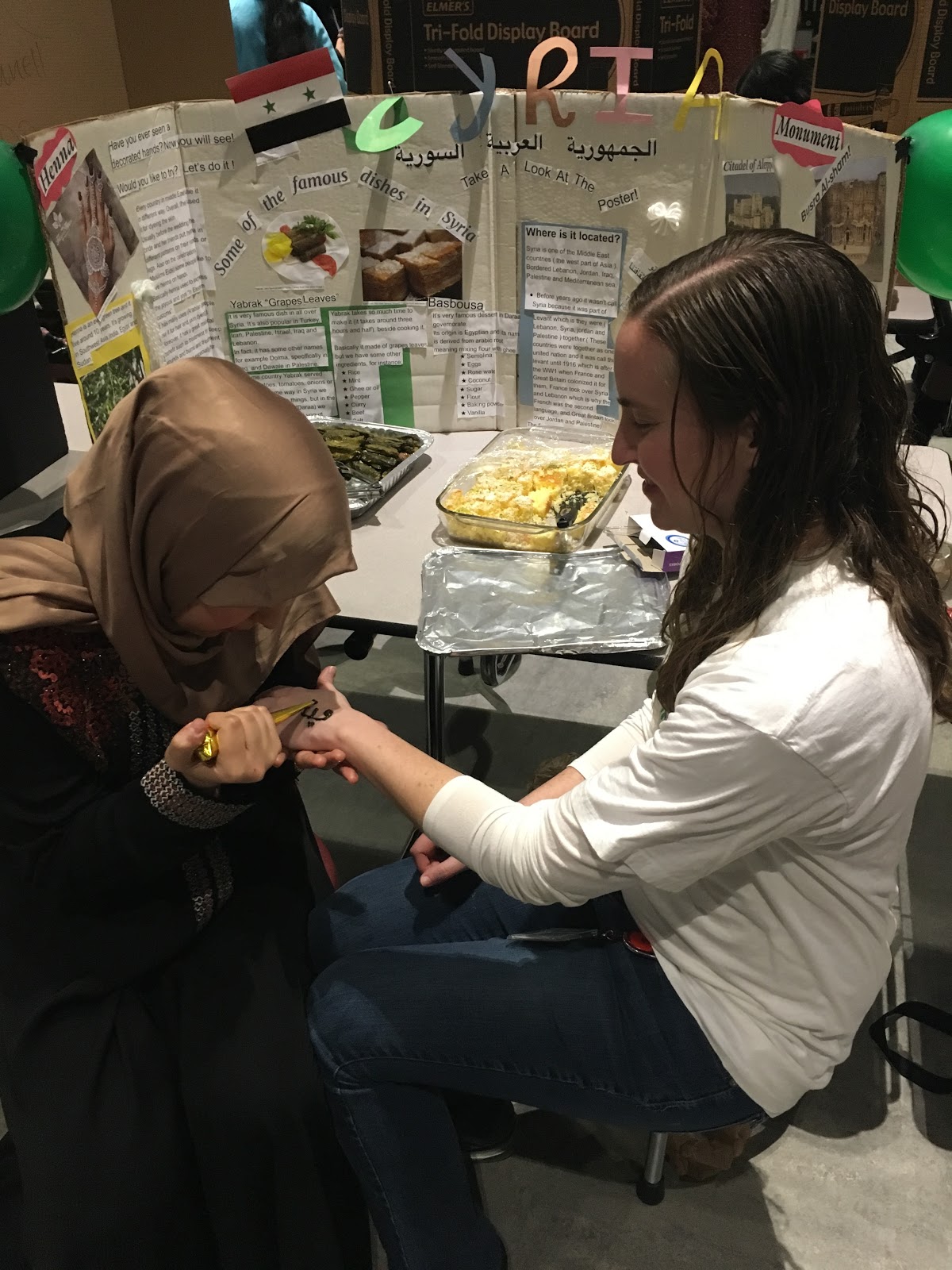
After a class period practicing their mini-presentations with their squad groups, my students were all fired up for the main event: our school's annual "Global Cafe", featuring over a hundred student displays showcasing our diversity. American students research their family's heritage, but my ELLs particularly shine as they bring their cultures alive with unique pride. Hundreds of students and staff members voluntarily fill the cafeteria for two hours after school to learn, share, and celebrate each other.

Balancing everything from Libyan pasta to Venezuelan arroz con leche to Iraqi baklava on my clipboard, I float through a vibrant sea of color, music, flavor, and the sweet chatter of unbridled pride meeting genuine curiosity.
K. teaches me all about Albania!
"I just have to tell you..." a science teacher comes bounding up to me. "Your student from Argentina... I think his name is M... he just did an amazing job! He was so enthusiastic and informative!"
As I scarf down some sweets from Qatar to make room for alfajores from Argentina, M. shows me how he organized his display by geographic regions. 
"Mrs. M!" S. practically skips up to me with a smile so big it might stretch right off her face. "There was a girl, and I wrote her name on her hand! Can I do yours?"
I hold still while S, in traditional Syrian clothes, writes my last name in Arabic on my hand with Henna!

A. gives my daughter a card where he wrote her name in Arabic!
M, in traditional clothing, teaches my daughter and me about Egypt!
When we have the time and space to share our stories, our differences remind us how similar we all really are.

Friday, March 11, 2016

Los sabores de México

Day 11 of 31 at TWT!
 Hace un año, mientras conducĂ­a a algĂşn restaurante cerca de nuestra case, notĂ© un letrero que me llamĂł la atenciĂłn: PALETAS Y NIEVES.

¡Hay pocos letreros en español en nuestra vecindario!
-- ¡Mira! ¡Creo que es una heladerĂ­a mexicana! ¡Las paletas son popsicles en español! -- gritĂ© a mi esposo. Decidimos que un dĂ­a de Ă©stos la probarĂ­amos... y casi se nos olvidĂł, hasta que una de mis estudiantes escribiĂł una entrada en su blog sobre los sabores singulares de esta heladerĂ­a especial. 

Cuando fuimos por la primera vez, juramos que Ă­bamos a regresar muchas veces para poder probar todos los sabores interesantes! Y cada vez que vamos, es casi imposible pedir sĂłlo uno o dos sabores.

¿Hay otra heladerĂ­a en Ohio donde se puede comprar tantos helados tropicales?
Todos caseros, todos con pedacitos de frutas frescas y dulces. ¡Y no basta con el helado! TambiĂ©n hay muchas paletas de sabores semejantes, con muchos trozos más grandes de frutas.

Además, hay aguas frescas de muchos sabores, postres de fruta, elotes, dulces, y otras comidas fascinates y ricas.

Un lugar mágico, donde se unen el español y el inglés, lo mexicano y lo estadounidense. La mayoría de los clientes son latinos, pero cada día vienen más estadounidenses para probar los sabores distintos, leer las palabras extranjeras, y escuchar la mezcla divertida de la música mariachi y el ritmo alegre de la gente charlando en español.

Un rincón de México que da la bienvenida a todo el mundo aquí en Ohio. La manera perfecta de terminar la semana.

Thursday, March 13, 2014

Writing beside them

13 of 31 at Two Writing Teachers!
Last week at this time, I had just spent an afternoon watching my students shine as they taught our whole school community about their countries. Now, a week later, I'm still dazzled when I remember their pride and excitement.

Even though I shared some of their displays, you didn't get to see the best part of their projects -- the powerful introductions my intermediate and advanced students wrote to give their visitors a personal sense of what they love about their countries.  From the beginning, I emphasized that while other students in our school were making displays about their family heritage, my students' personal experience would make their projects uniquely powerful.

After our initial brainstorming, I wrote a sample introduction in front of my students, talking through my craft decisions, revising, and using a thesaurus as I went. As the day went on, I just kept revising and adding more, so my afternoon class could see my process too. (The next day, I showed the changes to my first class.)

When most people think about Spain, they think about flamenco, soccer, and bullfighting. But when I think about Spain, I think about strolling through a maze of winding streets. I think of orange tile roofs and tan stone buildings filled with hundreds of years of memories.  I think of bright afternoons spent lingering in a lush park, reading and watching old men play Bocce. 

Along the streets, dried ham hocks hang in the windows of every bar and restaurant, beckoning visitors to enjoy some tasty tapas. My mouth waters as I remember crisp golden churros dunked in melted chocolate so thick and rich it's almost solid. I long for another sip of luscious Fanta Naranja, made with real orange juice and so much creamier than the American version... 

I'd often showed my students my writing, brainstormed in front of them, and jotted a few quick lines, but I'd never really written so deeply in front of them before. After reading Penny Kittle's Write Beside Them this fall, I realized how important it was for students to see the whole process -- how and why I revise as I write, my thinking as I make word choice and craft decisions, and how I continue revising after stepping away from a piece.

It was incredible. Their eyes shone with possibilities as they watched with rapt attention. They "ooh"ed and "ahh"ed whenever I made a decision that created a powerful line. They nodded their heads knowingly as I reminisced about how Spain just feels so much different than America... so charming, so peaceful, so steeped in history. As I wrestled with ideas in front of them, we were truly a community of writers... unique writers whose hearts hold memories of other lands and other ways of life.

At the end of the day, a student from 3rd period called me over. I thought he needed help, but he looked into my eyes and said "Mrs. M, what you wrote this morning... it made me feel like home." The smile that stretched across his face will live in my heart forever, reminding me to keep writing beside them. 

Thursday, March 6, 2014

Stories Hold Us Together

6 of 31 at Two Writing Teachers!
Today, more than usual, my classroom buzzed with excitement.

Today, more than usual, my students' eyes sparkled with pride.

Today, more than usual, they shared precious pieces of themselves and honored each other with respect, curiosity, and caring.

Today, more than usual, my students were really a part of our school community.

Today, more than usual, stories held us together. Not just as a classroom, but as a school, and as a school community that honors families.

This year's event logo, designed by a Computer Graphics student!
A joint project between several of my Iraqi students. A student who graduated last year even came to help out! Do you see the clay minaret in the bottom right corner? One girl made it just for this event!
When you visited their table, they would write your name in Arabic and give it to you -- a real crowd-pleaser! They made 100 cards for this and almost ran out!
These 2 boys decided to build their display like a giant Venn Diagram -- Saudi Arabia information on the left, Kuwait on the right, and shared culture in the middle!  LOTS of delicious food drew huge crowds!
3 students created this extensive display about Japan, complete with Manga, toys, games, art, money, & more!
The artwork on the table (there's also one on each side of the above Japanese display) was created by IB art students at our school, who read my students' StoryBox stories and then illustrated them. So cool!
This girl just came in November with no English. She was initially hesitant to present today, but my other students convinced and supported her, and she did a wonderful job!
A group of Mexican students put together this huge display, with several posters, food, personal photos, and a quinceañera doll! A huge victory happened at this table as one of my least confident students got so caught up in the excitement that she ended up standing on a chair, pointing out all her favorite pictures on her poster and rattling off information with the best fluency I've ever heard out of her!
This student's appearance was one of those moments you dream of! She usually avoids all speaking activities and actually swore until yesterday that she wasn't going to come, but other students' enthusiasm won her over!
This beginner student from Uzbekistan was extremely shy, but she brought such amazing artifacts that most of my other students said her table was one of their favorites. Again, it was simply incredible that she came out to share!
This student and her cousin wowed everyone with their beautiful Bengali clothing, in addition to the passion with which they shared their information (and food). 
After two frenzied hours of sharing and learning, a small group of students unwound in my classroom, reliving their experience and continuing to tell stories as we packed up supplies and cleaned up the chaos of the past few days. Flushed cheeks, heavy eyelids, deep breaths. Exhausted but proud. Home.

Glancing around the room, K. summed it up best. "I wish that we would always remember this day, right now... with everyone so happy."

Tuesday, November 5, 2013

They return when we remember

at Two Writing Teachers!
I didn't grow up celebrating Day of the Dead. Learning about it in Spanish class didn't even make much of an impression on me, probably because I don't really recall my teachers doing much to actually help us experience the unique atmosphere of this special holiday.  Of course, I hadn't experienced the death of anyone close to me at that point either.

Even when I was teaching elementary Spanish, it wasn't a big deal. Sure, it was fun to have the kids make calavera crafts out of noodles and interesting to discuss how it's really different from Halloween, but it was just another one of those fun little holiday celebrations... much like the ones I remembered from middle and high school Spanish classes.

That all changed when the second year I taught middle school Spanish.  I decided that instead of a video or craft, I really wanted my students to experience the holiday.  To help students design their own altars, I built one in my classroom... and I fell in love with the holiday.  I gathered up objects that reminded me of my grandparents: their favorite foods, Marine logos for my grandpas, jewelry and coupons for my grandmas... I even called my parents to find out more about what my grandparents loved. We ended up laughing over the phone, recalling silly stories and fond memories.  It was almost as if Grandma, Grandpa, Nannie, and Granddaddy really had come back to visit.

Last year, I really missed that.  I missed buying pan de muerto from the Mexican market.  I missed the little moments of sharing memories that helped my students and I see each other more clearly as people. And I missed remembering my grandparents.

This year, I did a mini-unit about Halloween with my beginner ELLs.  As I planned it, I could feel DĂ­a de los Muertos tugging at my heart.  Why not?  Wouldn't our study of Halloween be so much richer if we compared it to Day of the Dead?  They're both related to All Souls' Day. We could practice comparing and contrasting.  Maybe we could even explore how different cultures view death.  Besides, the Mexican students might love to share their special traditions, in the same way that my Muslim students loved sharing about Eid Al-Adha.  After all, my beginner ELLs need a lot of the same supports as my Exploratory Spanish students used to... we could design altars and then write about them too!

So I converted my old design-an-altar-and-write-about-it worksheet from Spanish to English and made it a little more complex. I reserved some library books, found a short video clip, and dug out the pictures of my classroom altar.  (Unfortunately, I didn't have the time or space to make one in my classroom again... hopefully next year!)


After watching the video, reading aloud, and talking about my altar (and my grandparents), my students were ready to design their own altars and write about them.  I'm always careful to let them know that they can design it for anybody, dead or alive: pets, celebrities, themselves, and fictional characters all work great if they don't want to design it for a real friend or family member. But just like when I taught Spanish, almost every student chose to either honor a real deceased loved one or a former pet.

Colored pencils scratched and markers smeared. Students bent over their papers with faraway looks in their eyes. As they asked for help with their sentences, we chatted about their special memories.

"How nice of you to honor your grandfather!" I remarked to my Iraqi student, who was busily coloring with a dreamy half-smile on her face.

"He die... yesterday." As she looked up at me, her eyes turned into swirling pools.

"Oh, I'm so sorry!" My words, suddenly thick and heavy, got stuck somewhere in my throat.  Should I tell her she doesn't have to do the activity?  But she really seems to be enjoying it!

"I did not see him for seven years."  She's lived in Egypt for the past seven years.

"Oh, so he still lived in Iraq?"

"Yes. He... my best friend." She gulped and bent her head back down to write and draw some more. Each time she called me over to help her with a sentence, I got another glimpse of her life in Iraq: walking with her grandpa around his farm, playing chess with him, watching sports together on TV, playing with his pet bird.  "I put a bird because he have this bird.  I like to see him happy."

When she finished, she had written more than anyone else in the class.

"He must have been very special."

Tuesday, October 22, 2013

My First Eid Al-Adha

at Two Writing Teachers!
As we walk from our car to the apartment building, H. comes bursting onto the front step, a whirl of wispy sky-blue sari and hijab.  Beneath her matching blue eye-shadow, her eyes sparkle with a giddiness that instantly reminds me of Christmas morning.  "Thank you for coming!!!!" she gushes as she leads us through the door.

Once we're ushered into the kitchen, a tantalizing mix of new and familiar sights and aromas floods my brain.  
Ooh, what are those?  
Oh boy, that's the same meat and rice she brought to school last year!
Wow, that dessert looks like just flan!

It looks like a reasonable amount of food for her family and us... until they declare that they've eaten so much all day that they're not going to eat!  All this food is for four people: me, my husband, my colleague, and her husband!
What a feast!
They grin while we take pictures of the food and giggle as we attempt to learn the Bengali names they teach us for each dish.  I can't remember them to save my life, but that doesn't stop my taste buds from relishing each new taste!

First, appetizers: something like egg rolls with an extra crunchy coating, and some little crispy dough balls.  My first tentative nibbles turn into enthusiastic mouthfuls.  Next, a delicious soup made of something similar to chickpeas (but whiter) with a special sour sauce to mix in.  H's mom absolutely glows with pride as we emit a chorus of "Mmmmmmm"s and dig in.  For the main course, the tender roasted meat and savory rice that I remember from the feast H's mom brought to school after finals in June.

Between bites, we chat about what I've read about the holiday and the family tells us about going to the mosque, visiting relatives, and preparing all the food.  Some family members actually went somewhere to butcher their own meat (an important part of Eid Al-Adha), and most of the vegetables are fresh from their garden!  As we pass food, laugh, and share stories, we are not two Christians, two Mormons, and a Muslim family.  We are not teachers, students, and parents.  We're just people learning from each other, discovering what we have in common, and enjoying time together.

And when our stomachs aren't sure they have any more room... not one but THREE desserts! I'm excited to explain to the family that one looks and tastes just like flan, which they've never heard of.  Another of the desserts is a different kind of custard, and the third is an intriguing bowl of tiny red balls, which H. keeps calling "the egg one".  All are delicious!

Excited by our interest in how the food was prepared, H's mom starts bringing plants in from the garden.  She shows us a chili pepper plant with the tiniest baby peppers I've ever seen, proudly flips through her phone to find pictures of out-of-season plants, and finally leads us out the back door, where the whole patio is covered in potted plants and trellises.  Her eyes shine with excitement as we "ooh" and "ahh" over the incredible variety of unique plants.

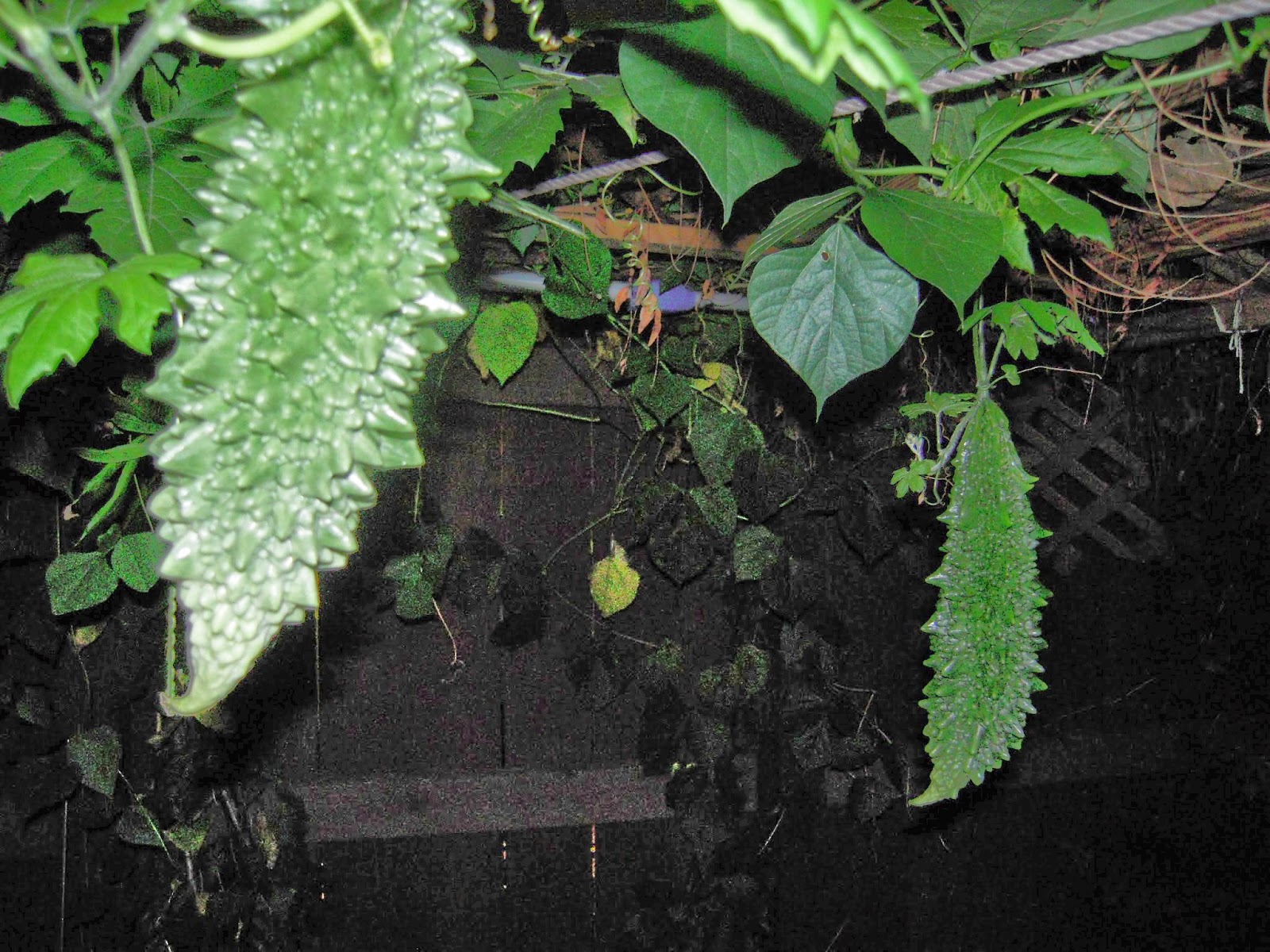
They told us the name of this vegetable in Bengali, but they didn't know it in English.
Does anybody know what it is?  I've never seen anything like it!
Too soon, it's getting late, and the family starts shoving leftover containers at us.  "We have much more," they urge us as we place modest amounts of food in a few containers.  When H.'s mom stops Husband from closing a container and starts shoveling in more rice with a serving spoon, we get it.  We are supposed to take ALL of the food!  They all beam as we pile it in the containers.  "Come back any time!"  "Yes, next time you must..."

Near the front door, H's dad is actually bouncing with excitement like a little boy. "We are so glad you come!" he keeps repeating as we try to thank him.

As we drive home, Husband and I can't stop chattering with that same Christmas-morning exuberance, and the same thoughts keep running through my head:
This is why I teach.  
I just made their day. 
World cultures are so cool.
What if I could connect this way with ALL my students' families?

Tuesday, October 15, 2013

All kinds of people

at Two Writing Teachers!
She doesn't even ask anymore if I'll be around after school. Now, she just shows up with an armful of books, grinning.

Almost every afternoon, we sit in my classroom: her dark hair hidden beneath an intricately decorated hijab, my blond hair partially tucked back with a barrette. Her Bengali accent gently lifts her words up and down; my steady American speech sounding flat by comparison. We furrow our brows over biology and chemistry, wade through pages of history, and dive eagerly into writing. Chats about books and classes morph into discussions of families, culture, government, and values. Gritted teeth and stress give way to giggles and smiles.

"I like to be around all kinds of people," she often tells me, as we discuss America or school.  

Lately, she's been teaching me about Eid Al-Adha and how her family prepares. I can't imagine having to do so much cleaning, cooking, shopping, and visiting in the midst of homework, and studying -- let alone actually having to miss school for the big day!  What would it be like if Christmas was just a normal day in a normal week of school?  I know the stress I see on her face would bubble up inside me as well.  However, that doesn't stop her eyes from lighting up with animated anticipation as she chatters away.

"You should come to my house for Eid!" she exclaimed one day last week.
"Really? I'd be honored... Check with your family, though!"
The next day, she walked into my class beaming. "My mom says you can come!"

So I asked what clothes I should wear ("just your normal clothes") and I started to read about the holiday. I'm captivated by the spirit of generosity that permeates the celebration, and I'm fascinated that it has its roots in that story about Abraham's willingness to sacrifice his son. I learned that story in Sunday school. How can so many wars have been fought between people who share the same stories?

When it comes right down to it, all kinds of people have a lot more to bring us together than to separate us. H. knows that, because she sees people's hearts.  With students like her building the future, I hope a lot more holiday celebrations will look like the one I'm attending tonight: all kinds of people being human together.

Sunday, March 3, 2013

Global Café Read-a-Latte

Day 3 of 31 at Two Writing Teachers!
As soon as I stepped through the double doors to the cafeteria, I knew this was an event unlike any other.  An excited buzz of teenage voices hummed over a cheerful backdrop of Irish fiddle music as my eyes scanned the living tapestry of unfamiliar sights.   Chattering students with sparkling eyes milled around, clutching myriad foods and drinks I'd never seen before.  Dozens of trifold display boards trumpeted the names of countries near and far, beckoning with stunning photos and fascinating information.  At the other end of the huge room, the fiddlers tapped their feet and nodded their heads in concentration.

Dazzled, I began to weave my way through the display tables.  "These are samosas: fried dough filled with potatoes and peas, and this is mango juice," a sari-wrapped girl informed me.  My tongue tingled with the sweet tanginess of the juice as she talked me through her display about India.  At the next station, I sampled soda bread as I learned about the history of Ireland.  Next, I viewed wedding photos of one girl's Italian great-grandparents.  Delicious Japanese rice balls with edamame, sweet tamales, creamy Persian pudding, crunchy Indian dough twists whose name I can't remember... my tongue was dancing with delight as my brain contemplated the history and culture of each country.

After a whirlwind tour around the world, I sat down in the performance area for further amazement.  Athletic yet stoic Taiko drummers bobbed and bounded between their drums, in sync with each other and the music.  Energetic dancers in beautiful outfits gestured with theatrical style as they filled the air with Russian songs.  Two boys performed their own rap songs with positive messages.

Through it all, the other students circulated and stared in rapt attention, supportive and clearly impressed with their classmates' heritage and talents.  Gathered after school, casting aside other commitments, dropping fears and preconceptions at the door.  That afternoon, it was clear: our school is a world community, where cultural heritage is an asset to be shared.  Embodying one of my favorite Thoreau quotations: "Could a greater miracle take place than for us to look through each other’s eyes for an instant?"

(Global Café Read-a-Latte was a special two-hour event after school on Thursday, held in conjunction with Read Across American Week and Dr. Asma Mobin-Uddin's visit.)

Wednesday, June 13, 2012

¡Vamos de compras!

Since my 6th & 7th grade programs are eliminated and I won't even be teaching Spanish anymore, I'm going to try to share a whole bunch of my favorite activities from those programs over the summer.

A favorite activity that I've done with several different topics (food and school supplies, and I can also see it being done easily with clothing, although I never got around to it!) is shopping / the marketplace.  It's just what it sounds like -- our classroom becomes a live marketplace or store where the kids buy and sell plastic realia (and pictures of items when I don't have enough!).  For money, I invested in a lovely set of fake-but-authentic-looking euros and the kids LOVED using them!  In addition to authentic money, there are several opportunities to weave culture into this activity, such as markets / small shops, cultural icon stores like El Corte InglĂ©s, how to say prices, and even exchange rates.
two 7th-graders interacting at a "school supply shop"
Some students volunteer to be "shop owners" -- responsible for setting up their "store", handing items to the "customers" when they ask for them (listening), telling customers the cost of their items (speaking), and making change (life skill!).  To create several stations, I categorized the items into several specialty "shops" (bakery, fresh fruits & vegetables, butcher shop, dessert shop, etc.), giving each "shop" a big bag with their items to sell, signs, and money to make change. (Small shops are a cultural element common in Spanish-speaking countries anyway, but you could make specialized areas of a large store, depending on your situation.) Many of "shop owners" get into their role so enthusiastically that they'll "advertise" for their store, yelling our items and prices in the TL to attract more "customers"!

The other students are "customers", who have to make a shopping list on a budget (writing & life skill!), ask for the items they want (speaking), and pay the correct amount of money when asked (listening).  If they're interested, I try to let the shop owners swap with a customer partway through, so they can experience both roles.

While this activity tends to be SO engaging that some kids will try to slip into English more than usual at first, it's awesome once everyone gets going in the TL (like always, close monitoring is the key!).  The best part is when those super-enthusiastic students dive thoroughly into their role and start telling the "English-sneaking" kids "I don't speak English"!

I love it because it creates a completely authentic way to use language, plus the chance to "experience" some of those cultural elements!  As for the kids, they rush around with sparkling eyes and always list it as one of their favorite activities.

Thursday, May 10, 2012

Los Famosos (communicative activity)

Another favorite activity my students do with numbers is "Los famosos".  During their numbers unit, my 6th graders don't learn to tell time but they do learn to talk about numerical personal information like birthdays, ages, and phone numbers.  To wrap everything up and practice towards the end of the unit, we do this activity:

front of a card
Each student gets a card with a famous person from one of our three culture-focus countries for the trimester (Mexico, Ecuador, and Costa Rica in 6th grade).  They are now this person :-) and have to exchange personal information (one-on-one) with the other "famosos" in the class.

Each two-sided card has the person's picture and name on the front and personal information on the back.  Students walk around the room holding the front facing out so they can read their "own" information on the back and their classmates can see "their" picture and name.

back of a card
The students always get such a big kick out of why they are famous!  The most excited students are always the presidents and the athletes, but I included a wide range of celebrities, from actors and musicians to artists and writers.  I also made sure to include people of all different ages; the "famosos" range in age from teenagers to 90-year-olds!

In addition to their numbers unit vocabulary, they get to review other personal information and learn new vocabulary about jobs from why their person is famous.  To give their personal information correctly, they have to remember other cultural/linguistic concepts from the unit such as date format (DAY/MONTH/year), years ("one thousand nine hundred sixty-three"), and phone numbers ("two hundred fifty-five, ninety-nine, fifty-eight").  Plus, they get to learn about famous people from our three countries!

While they are interviewing their classmates, the students have to fill out a chart to record their classmates' information.  As in the "turistas" activity, the chart guides students in asking the questions and ensures that they have to understand the information they hear.

chart to fill in
Like many other activities I've shared, this one is a winner because it gets included as an answer to both "What activities did you LIKE this most?" AND "What activities helped you LEARN the most?" on the end-of-unit survey!


Thursday, April 26, 2012

Turistas (communicative activity)

Wow, it has taken me forever to finish writing about the activities from the numbers/Spain unit that I wanted to share!  This one is my favorite by far, and also a student favorite, which is always exciting.  Half of the students are "tourists" visiting Toledo, Spain and the other half are "tour guides" with information about famous sights in the city.  Each "tour guide" stands in a certain spot in the classroom and the "tourists" work their way around the room "visiting" different sights.  Halfway through, we switch roles so everybody gets to be a "tourist" and everybody gets to be a "tour guide".

My students get really excited when it's their turn to be "tour guides". The "tour guides" each have a card with a color picture of their designated sight on the front and a copy of a real tourist information sheet that I got when I visited Toledo.  Many of them get really into their role and do a great job of "marketing" to the tourists by calling out the name of their place, holding up the picture, etc.

front of a "tour guide" card
Information sheet on the back of each "tour guide" card
When the "tour guides" talk to a tourist, they hold up the card so the tourist can see the front of the card and they can see the information on the back.  Information about their place is highlighted so they can find it easily.  They have to use this information to answer questions from the tourists in Spanish.  Since all numbers are written numerically on the information sheet, the tour guides have to really use their numbers vocabulary (plus all the extra cultural concepts we've learned, such as how to say phone numbers, how to read 24-hour times, and how to say prices) as they give the information.

Here's the original information sheet with no highlighting, in case you want to use it!
The "tourists" have a table with all the questions to ask at the top and rows to fill in information as they visit each place.  They get to record the numbers numerically, which means they have to understand everything their tour guide tells them.  Since these are all useful questions that they might have to ask while traveling or planning a trip, it's really authentic listening and speaking practice.

In addition to being a fun activity because it gets the students out of their seats and interacting authentically, this activity is usually one of the most-repeated answers to "Which activities helped you LEARN the most?" on our end-of-unit survey.

I've created a similar activity for my 6th graders with places around Quito, Ecuador.  (It's a little simpler because they don't learn how to tell time, but it works the same way.)  It takes a little research to create for a place you haven't visited personally, but many cities now have tourist resources posted on their websites that could be used as the basis for activities like this.

Monday, April 9, 2012

En Sevilla... (pair speaking activity)

Last week I shared a writing activity my 7th graders do with places in Madrid.  I was hoping to share a few more of my favorite activities from that unit, but life got in the way, as it often does.  So finally, a few days late, here's another activity I'm proud of: "Sights in Sevilla".

In this partner activity, students ask and answer questions to exchange information about famous sights in Sevilla, Spain.  I used this authentic information sheet from my trip to Sevilla (it's from the back of a map) to create the activity.
original Sevilla info sheet
Partner A and Partner B each have modified information sheets with critical information blacked out for SOME of the sights. (Thus, A can see information that B can't see and vice versa.)
(Partner A & B info sheets w/ opposite blacked out info.)

Each student has to ask his/her partner for the missing information (related to our numbers/time vocab) about each designated sight: opening time, closing time, and phone number.  (i.e."What time does the Museo Taurino open?" etc. -- you can see an example above the chart screenshots below.)  To answer the partner's questions, the student must find the correct information about each of the partner's sights on the info sheet.  Of course, all asking & answering MUST be done in Spanish!  While listening to their partner's answers, students record the information (numerically) in the following charts:

Partner A's chart to fill in
Partner B's chart to fill in
After both students have exchanged all the information about their sights, I have them pick two sights that they'd like to visit.  They have to work together to write about what the sight is and why it's important / why they'd want to visit it.  As in the Madrid activity, I run a self-scrolling PowerPoint with pictures of Sevilla on the big screen throughout the activity.  And just like that activity, students really respond to the realia and enjoy learning about the sights much more than if they were just exchanging made-up numbers and times to practice vocabulary by itself!

I love info-gap activities for so many reasons:

  • students have a real reason to communicate
  • they get to ask/answer questions they might actually ask & answer in real life
  • having a specific task to complete keeps them on-task 
  • designing the activity around vocab they are practicing keeps them in the target language
  • they get to practice both speaking and listening at the same time!
  • since it's a pair activity, students often correct/help each other with language usage

In fact, I love them so much that my students end up rolling their eyes when it's time to do another one... but the vast majority of students always list them under "What helped you LEARN the most?" in our end-of-unit surveys!  (Even students who don't list them under "What activities did you LIKE the most?" -- although many students include them there as well!)